
← All postsGuide
Fake accounts and impersonation: who is using your brand?
From a fake Instagram account to a fake franchise offer: the impersonation types organisations meet most often, and four steps that work against all of them.

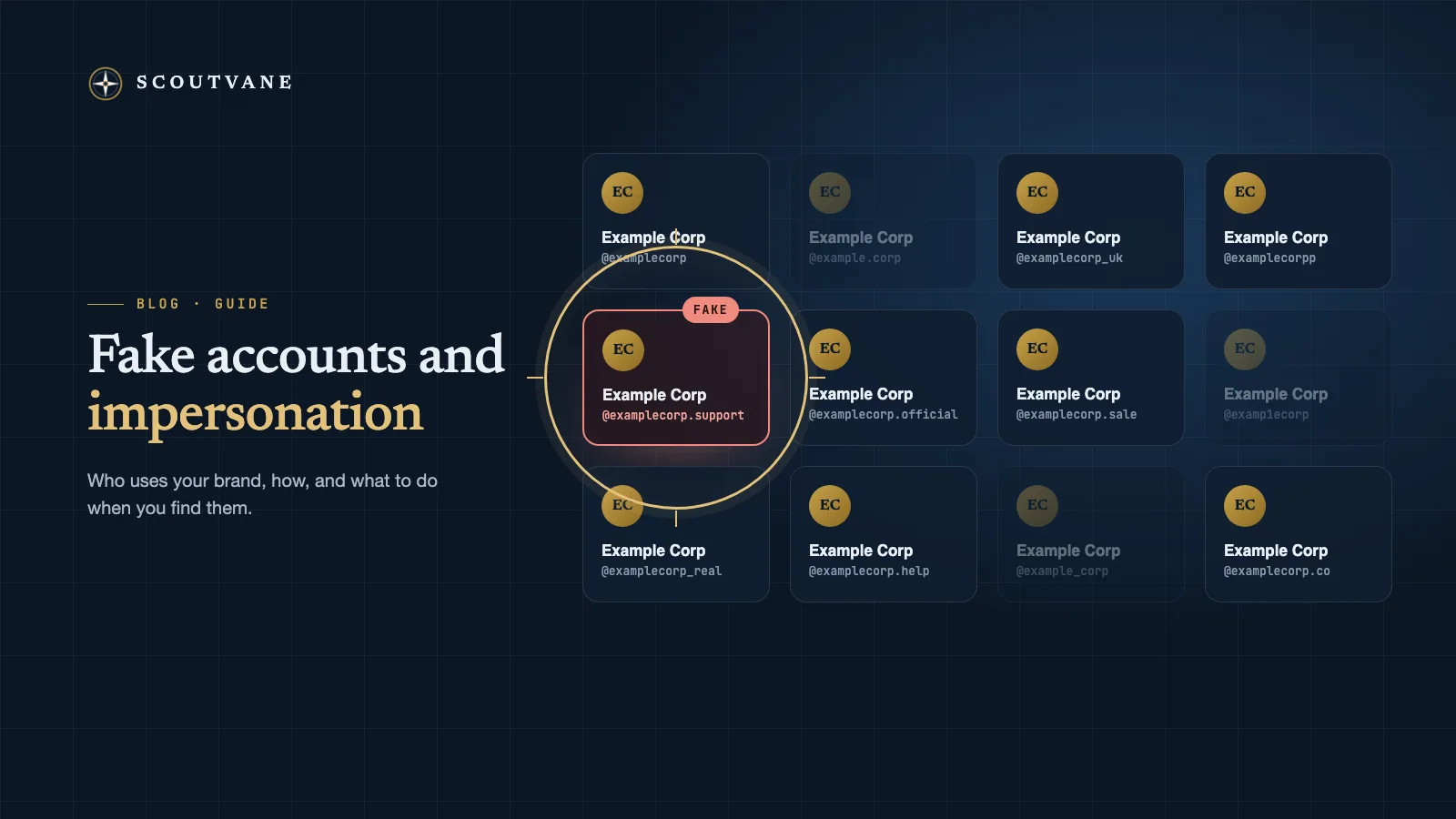
A message lands in customer service: "I ordered through Instagram, I even sent the money, and the product still hasn't arrived." There is no such order in your system. The customer is understandably angry, and you are trying to work out what happened. Then someone sends a screenshot and it all makes sense: your customer was not talking to you, but to an account using your logo.
This scenario happens so often now that for most organisations the question is no longer "if" but "when". In this post I'll go through the nine most common forms of fake accounts and impersonation. You don't need any technical knowledge; at the end there is also a simple sequence you can apply against all of them.
First, one thing to know
If you try to memorise these nine types one by one, you'll get tired. But look closely and you'll see they all tell the same story.
The impersonator has something you earned over years: people recognise your name and relax when they see your logo. The fraudster uses exactly that. First they look like you: your logo, your name, your colours. Then they rush people: the campaign ends tonight, only three items left, applications close tomorrow. Finally they pull the conversation out of the place everyone can see and into private messages, WhatsApp or their own website. There, nobody can compare them with you any more.
A familiar face, a rush and a private message. Almost every impersonation case is made of these three parts.
Once you notice this, you'll recognise the types below easily.

The account impersonating you on Instagram
This is the most common type. The account has often been opened only a few days earlier; it copies your logo and a few of your product photos, then either runs ads or writes one by one to customers who comment on your posts.
It is hard to tell apart at first glance, but the details give it away. The username has an extra dot, an underscore, or a word like "support", "campaign" or "official". It has few followers, and the posts were all uploaded together within a few days. The real giveaway, though, is the payment method: it asks for money by private message and bank transfer, which you never do.
When you see an account like this, the first job is to keep a record: a screenshot, the account's address, the date. Then report it from the account's menu, stating that it is pretending to be someone else. If you don't have an Instagram account, or your report gets nowhere, the Instagram Help Centre has a separate form for impersonation reports.
Fake pages on Facebook and ads run in your name
On Facebook things go a step further, because the fake page pays to run ads in your name. Since ads are shown to people who have never followed the page, the damage spreads much faster.
There is one good side to this: ads on Facebook and Instagram are kept in a publicly open archive. If you go to the Meta Ad Library (facebook.com/ads/library) and type in your organisation's name, you can see every page running ads in your name. Doing this even once a month will help you catch many fake campaigns early.

You can report a fake ad from the menu in the corner of the ad, and the fake page from the page's own menu.
On X: parody or impersonation?
On X the situation is a little different, because the platform allows parody and fan accounts. So an account poking fun at you is not against the rules in itself. But there is a condition: the account must say clearly in its name and bio that it is a parody.
When drawing the line, ask yourself a simple question: could an ordinary user genuinely mistake this account for you? An account that copies your profile exactly, says "parody" nowhere and makes announcements in your name is not a parody. Report it as impersonation from the profile menu.

On TikTok: accounts that copy your videos
Here the aim is often not to defraud anyone straight away. Someone who downloads your videos and posts them on their own account is first collecting followers. Once they reach a few thousand people, they either sell the account or start announcing fake campaigns to the same audience.
If the copied video is yours, use TikTok's copyright notice. If the account also uses your name and logo, file an impersonation report as well.
You may not be the first to reach your complaining customer
This is the least known type and, in my view, the most dangerous. Your customer posts a complaint on social media. Within a few minutes an account called "Example Corp Support" replies: "We're sorry about the problem you've had, let's fix it right away. Please send your details through this form."
The form is not yours. Your customer types their card details, their password or the code that arrives on their phone into it. And they do it believing that you are helping them.

The best defence against this is speed. Answer complaints quickly from your official account, and say the same sentence every time: "Contact us only through this account and our own website; we never ask you for card details." A customer who has read this sentence once is very unlikely to believe a fake account.
WhatsApp: what can we see, and what can't we?
Let me be frank here: WhatsApp conversations are end-to-end encrypted. Neither you, nor I, nor any monitoring tool can read other people's WhatsApp messages. Be wary of anyone who tells you otherwise.
What we can see are the traces that spill outside WhatsApp. If the fake number has been shared on a website, in a listing or on a social media profile, that is public. If customers leave notes on complaint sites saying "They wrote to me from your WhatsApp line", that is visible too.
The person who receives the message can report the number from the chat screen and block it. Your job, if you have an official WhatsApp line, is to state it clearly on your website. If you don't, even saying "We do not sell through WhatsApp" protects many people.
Fake job ads and fake dealership offers
I'm covering these two together, because in both the target is not your customers but people who trust you and want to join you.
A fake job ad usually starts like this: "Work from home, two hours a day, weekly pay." Your company's name appears in the ad. The applicant is first asked for a "training fee", a "shipping cost" or a photo of their ID. A fake dealership offer plays for bigger stakes: a carefully prepared presentation, realistic-looking figures and a deposit "to reserve the territory for you".

In both cases the harm runs two ways. The person who sends money is defrauded, and your name starts to be talked about as a "fraudulent company". The precaution is actually simple:
- Add the sentence "We never ask for any fee at any stage of the hiring process" to your careers page.
- If you offer dealerships, state only the address from which you receive applications; if you don't, say so openly.
- Reply the same day to anyone who writes "I received an offer like this, is it real?" These questions are the warnings that let you spot a fake offer earliest.
Why is trademark registration so important?
In most of the complaints I've described above, the platform will sooner or later ask you: "How do you prove you own this name or logo?"
If your organisation's name and logo are registered with the Turkish Patent and Trademark Office (TÜRKPATENT), the answer is ready. The trademark complaint forms of Meta, X and TikTok ask for a registration number, and these forms are reviewed more seriously than ordinary complaints. Registration is not a guarantee that the fake account will be closed, but it is the strongest document you have. I suggest you ask a trademark attorney or your lawyer about the cost and the timeline.
Whatever you run into: four steps
A fake account, a fake ad, a fake listing or a fake dealership offer. Whichever it is, the sequence to follow is the same.

Record first. Before you report. The account's address, a screenshot, the date and time; if possible, an independent archive copy of the page. The moment you report, the account may vanish, but the record stays with you.
Then report. From the platform's own menu, with the right option. If you have a registered trademark, use the trademark form. If someone has lost money, this is now a matter of fraud; the victim needs to go to the police or the public prosecutor's office. For the legal process, consult your lawyer.
Warn your customers. Gather your official channels in one place: your website, your accounts, your phone line. Saying "Anything outside these is not us" protects far more people than reporting one by one.
And keep monitoring. A closed account often comes back a few days later under a very similar name. It takes regular checking for a while.
Five things you can do this week
- Add a short "Our official channels" section to your website: your accounts, your phone, your email.
- Search for your organisation's name, and its most common misspelling, once on Instagram, X and TikTok.
- Look in the Meta Ad Library at pages running ads under your name.
- Add the sentence "We do not charge fees in hiring" to your careers page.
- If you have no trademark registration, write to a trademark attorney and find out the cost.
It is possible to do all of this by hand, but doing it regularly every week is hard. I'm building Scoutvane for exactly this: it scans your organisation's name across publicly accessible sources; it finds impersonating accounts, fake domain names and the comments under posts, and it stores every finding with its evidence. It cannot see WhatsApp conversations or closed groups; the report says plainly what it can and cannot see. If you'd like a free preliminary scan for your organisation, you can write to me.